April 22, 2026Series Spotlight

Investigating the Wicked: A Dark Fantasy Saga About the Last Monster Hunters of a Dying Order

Why I wrote Investigating the Wicked: the world of Strohr, the Investigators' dwindling order, the hidden conspiracy hunting them, and where to start reading for free.
Dark Fantasy
Investigating the Wicked
Monster Hunter Fantasy
Worldbuilding
Medieval Fantasy
Indie Fantasy
Dark Fantasy Series
Investigating the Wicked: A Dark Fantasy Saga About the Last Monster Hunters of a Dying Order
Evil does not appear fully formed. It compounds. It begins in a quiet choice, then another, then another, until the thing that stood against it is so outnumbered that holding the line becomes the only victory left worth counting. That is the spine of Investigating the Wicked, the dark fantasy saga I've been building across a world called Strohr. At the center of it is a man named Kavel. He is one of the last Investigators of the Wicked, a once-numerous order that rose centuries ago to stop a dying world from being consumed. He is very good at his work. He is also being hunted, and so is everyone like him, and for a long time he did not know why. This post is for readers who haven't found the series yet, and for readers of the first books who want to know more about how the world fits together.
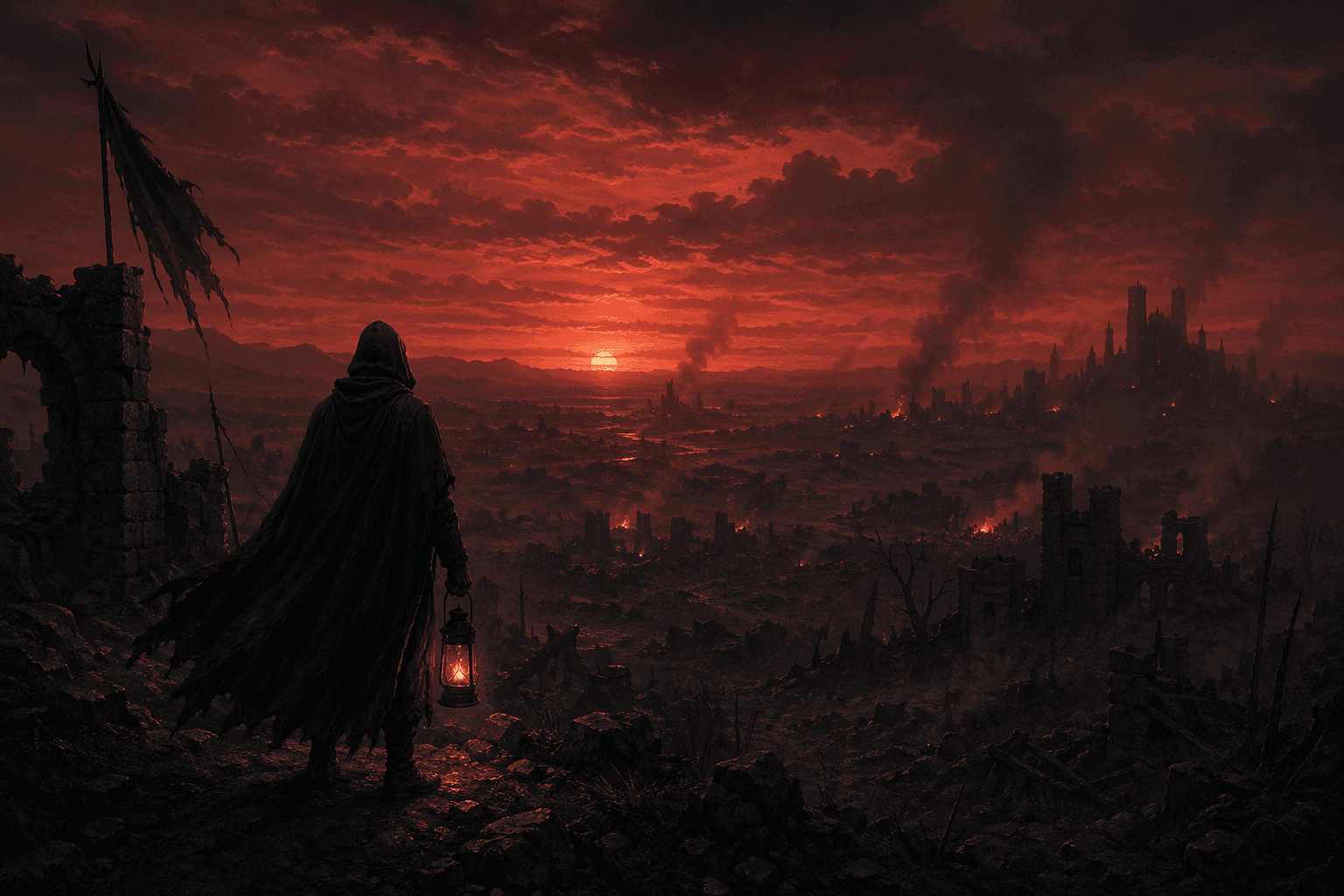
A map's worth of mood: the cold medieval world of Strohr where Investigating the Wicked unfolds
Strohr is a secondary-world dark fantasy setting. Medieval-ish in technology. Cold in tone. Built so that geography carries weight rather than simply exists as backdrop. A few of the places readers have already walked through across the first two books:
  • Graamoor, a small village in the north where no one can speak. The curse was placed by a dark spirit in exchange for one man's suffering, and the villagers have built a whole quiet life around writing instead of talking. It is the first arc, and the mood of Graamoor sets the tone of the saga.
  • Archeopp, a bustling trade city in northern Strohr governed by a Council of prominent citizens. Beneath the markets, an illegal creature-trafficking operation went wrong. A scalefiend escaped. Two citizens died before Kavel closed it.
  • Vaarmir, a fortress city of black stone walls sixty feet high and mage-protected gates, where vices are legal and regulated on the philosophy that it is better to control sin than pretend it doesn't exist. Kavel was almost killed there by a demon summoned to murder him specifically. He was then blamed for the destruction and banished so the city could hide what had actually happened.
  • The Antler & Hearth, a three-story crossroads inn two days south of Vaarmir where a merchant was murdered inside a bolted room. Kavel locked down thirty people, worked the case as a psychological interrogation, and walked the guilty into their own confession.
  • The Wallace Kingdom, the political center of the map. Noble houses, old money, a king with guarded advisors. More of the Conclave's thread runs through here than anywhere else in Strohr.
The historical backdrop matters too. A brutal mercenary campaign called the Velden Campaign ended eight years before the main timeline. The Wallace Kingdom hired the Velden Company to crush a tax rebellion. The company burned villages, raped, scattered survivors. The rebellion ended. The Company was paid. No one was punished. That unpunished cruelty is still alive in the survivors who carry grudges, and in the way Strohr has learned to accept a certain baseline of wrongness as normal. It is the kind of history that earns the title dark fantasy without chasing it. The order's origin is the single most important piece of worldbuilding in the series, and the blog post I am replacing got it completely wrong. So here is the truth of it. Three hundred years ago, Strohr entered what the chronicles call The Dark Period. Evil had grown unchecked for generations. Monsters bred. Dark mages gathered power. Curses moved between villages the way plague moves between bodies. Every kingdom fought alone. Every kingdom was losing. The Wallace Kingdom lost half its population in twenty years. The Investigators rose as the response. Not an army. A dispersed network of trained hunters who moved case by case, kingdom to kingdom, and went where ordinary authority could not. They hunted monsters, dark mages, curses, supernatural crimes, and, when the wicked happened to be a person, they hunted people too. The line between human evil and supernatural evil has never been clean in Strohr. Sometimes the wicked is a curse. Sometimes it is a mercenary captain. Sometimes both are the same case. At their peak, the Investigators numbered in the hundreds across the continent. At the point where Kavel's story begins, a dozen remain, maybe fewer. For years, each loss read as accident, misfortune, the price of dangerous work. It was not.
The last Investigators of a dying order, holding a line no one else can see
Kavel is my protagonist. Veteran. Stoic. Sharp-witted. Observant to the point that interrogations with him feel less like a conversation and more like being read. He was born into the work. Generations of Investigators in his bloodline. No choice in becoming one, no ceremony. Inheritance. On the surface he is cold, short with words, direct when he speaks. Underneath, if you break the wall, he is the softest person in any room. The coldness is armor. The black and white worldview is a coping mechanism, because in Strohr the grey is where most of the dying happens. His power is the silver light of his bloodline. Kavel can shape it into solid forms. Blades that cut things normal steel cannot. Shields that block supernatural attacks. Chains that bind creatures and demons. A half-dozen darts that orbit him and strike on command. Reactive wisps that intercept threats without his thinking. The light responds to intent rather than instruction, which means it gets stronger the more he opens up emotionally, and weaker the harder he closes down. That tension is the engine of his arc. Two figures shape him more than any other:
  • Marrek, his father. Also an Investigator. Taught him the blade, taught him the trade, took him on his first field case at sixteen, and died years later of what everyone called fever. It was not fever.
  • Theron, his mentor. An elder Investigator who works in shadow magic rather than light, and who practices a forbidden skill called Mind Walking, the ability to step directly into another person's memories. Theron is the one who first tells Kavel that the order's losses are not coincidence.
The Conclave is the enemy behind almost every case. They are an old, hidden conspiracy spread across noble houses, religious orders, merchant families, and places you would not normally think to look. They operate at the level of generations. They have no crown, no army, no visible territory. What they have is patience, a shared purpose, and a belief that the Investigators are the last remaining threat to whatever it is they are building. Their purpose, in the simplest terms, is to end the Investigator line forever. Not the monsters. Not the curses. The hunters. Because without the hunters, the rest of what the Conclave is doing becomes a lot easier. Inside Book 3, the Conclave's inner circle is already fracturing. A member called the Summoner pushed for an ambush that nearly finished Kavel and his allies, and the other members of the inner circle resented it. One of them, Lord Edric Varent of the Wallace Kingdom, is dead. The others are still out there, still moving, still compromised in ways that make them exploitable if Kavel can reach them before the Summoner reaches him first. On paper the series is about monster hunting. Case by case. Village to village. A man with a blade of silver light working problems that ordinary law cannot solve. Under the paper, it is about something else. It is about how evil compounds. How an order of hundreds becomes an order of a dozen without anyone quite noticing the slide. How ordinary human choices, made one at a time, build into a Conclave. How a fortress city decides that regulating sin is easier than resisting it, and how a mercenary company walks away from a razed village because the paperwork was clean. The series does not ask who is evil. That is the easy question, and it is the wrong one. It asks how evil happens, and who dares to confront it when confrontation is a losing position. That question is the one I keep writing, in different genres, in different shapes. My thriller Recall asks the same question about forbidden knowledge in a modern setting. My literary sci-fi Adjacent asks it about a civilization that confirms the existence of parallel realities. Investigating the Wicked is the dark-fantasy version of the same spine. It is the one I feel the most at home in. If you want to test the series without committing, start here. The First Hunt is my free prequel novella. Around 15,000 words, five chapters, each its own page on the site. No email wall. No signup. It is set a year before the main timeline and follows a sixteen-year-old Kavel on his first real case with his father Marrek. The two of them ride south into a flowering valley called Lastar that is too green for the season. Something old has started feeding on the villagers. The seal that once held it was broken recently, and deliberately, by someone who should not have been able to. It is the first thread of the Conclave, pulled before the order knew a Conclave existed. If you want the full saga: The full Kevin Gabeci catalog, including eleven published books across dark fantasy, thriller, and literary fiction, lives at books.kevingabeci.com and on my Amazon author page. The comparisons I get most often and the ones I've learned to lean into:
  • Andrzej Sapkowski, The Witcher. If you like a veteran monster hunter working case-by-case across a morally grey medieval setting, you will find a lot to enjoy in Kavel.
  • Glen Cook, The Black Company. Cold prose, soldier-of-fortune mood, a magical threat you feel more than see. Investigating the Wicked shares that register.
  • Joe Abercrombie, The First Law. Patient plotting, fractured villain hierarchies, characters whose black-and-white worldview keeps getting dented. That is the school I write in.
  • Patrick Rothfuss, The Name of the Wind. Not a tonal match, but similar density of worldbuilding and lore seeded slowly rather than front-loaded.
If three of those four names made you nod, the saga is probably for you.
I'm Kevin Gabeci. Software engineer by day, writer the rest of the time. Eleven books published on Amazon Kindle across dark fantasy, thriller, and literary fiction. Long-time writer on Medium, verified Book Author on the platform. I spend a strange amount of time thinking about monster hunters, hidden conspiracies, and the slow ways ordinary people make the world worse. You can follow my writing on Medium or reach me through the portfolio.

Frequently asked questions

What is Investigating the Wicked about?

It's a dark fantasy saga set in the world of Strohr. Kavel, a veteran Investigator of the Wicked, is one of the last members of a centuries-old order that once held the line against monsters, curses, and dark magic. The order is dying. Someone is picking off its members, one by one. As Kavel works each case, from a silenced village to a locked-room murder to a demon summoned inside a fortress city, he uncovers the truth: a hidden conspiracy called the Conclave of the Dying Light is working to end his kind forever. Two books are live on Amazon Kindle, and a third is being written now.

Where can I start reading for free?

The First Hunt is a free prequel novella, roughly 15,000 words across five chapters. It's set a year before the events of Book 1 and follows a sixteen-year-old Kavel on his first field case with his father Marrek, in a flowering valley where something older than the Investigators has started feeding on villagers. No email signup required.

Is the series finished or still being written?

Book 1 and Book 2 are complete and available on Amazon Kindle and Kindle Unlimited. Book 3 is being actively written in 2026 and will release on Kindle once complete. The full saga is planned across multiple books, each one deepening the world and closing more of the mystery of what happened to the Investigators.

Who should read this?

Readers who love dark fantasy with a monster-hunter frame, morally complex worldbuilding, slow-burn conspiracies, and villains who are not cartoon evil. If you enjoyed The Witcher by Andrzej Sapkowski, Glen Cook's The Black Company, or Joe Abercrombie's First Law trilogy, Investigating the Wicked should sit comfortably on the same shelf. The prose is spare and cinematic. The mood is cold and careful. The cases are built like mysteries first, set pieces second.

What other books have you written?

I have eleven books published on Amazon Kindle across dark fantasy, thriller, and literary fiction, including Shadows of Ravenshore, Adjacent, Recall, Offline, Sleep Mode, Dead Internet, Terms of Service, 0 Days, and Ship After 5. The full catalog lives at books.kevingabeci.com and on my Amazon author page.