September 18, 2026

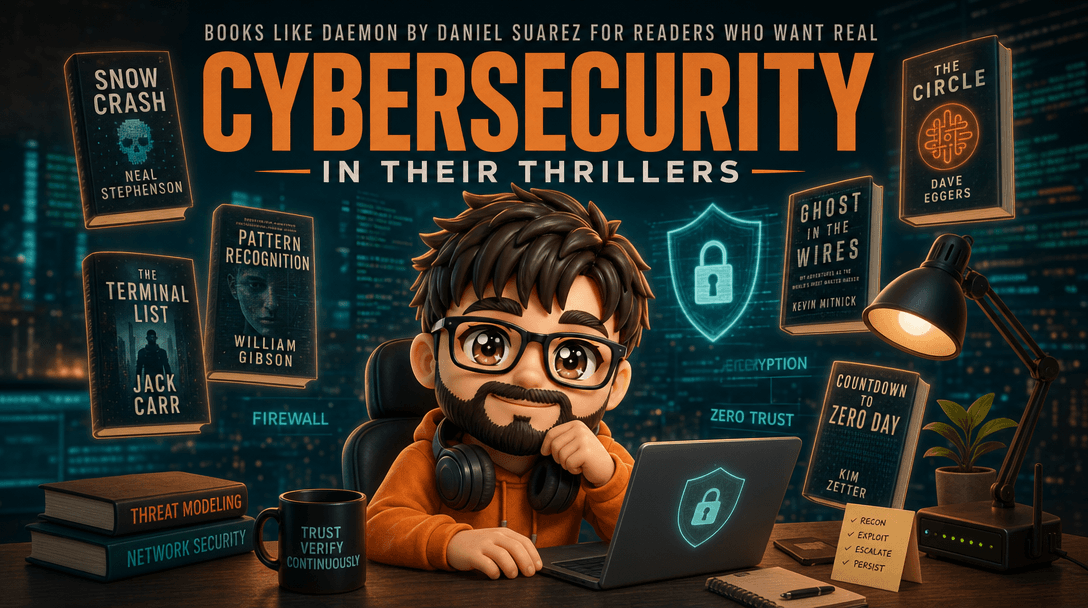
Books Like Daemon By Daniel Suarez For Readers Who Want Real Cybersecurity In Their Thrillers

Most cyber thriller fiction triggers eye rolls in actual security people. A small subset uses the real vocabulary, nmap, Burp Suite, Wireshark, Ghidra. Five novels that get the work right.
Books Like Daemon Daniel Suarez
Realistic Cybersecurity Thriller Books
Books For Hackers Fiction
Books Like Neuromancer Modern
0 Days
Cyber Thriller Novels
Books Like Daemon By Daniel Suarez For Readers Who Want Real Cybersecurity In Their Thrillers
If you have ever worked in security, you know the eye roll. A character in a network drama puts on dark glasses, types a few sentences in a green terminal, and announces that they are in. The hacker in a movie always wears a hoodie. The hacker in a thriller novel always says something about firewalls being down. The vocabulary is wrong. The workflow is wrong. The pacing is wrong. The whole thing is built by people who have never sat through a four hour Burp Suite session waiting for an authenticated scan to finish. There is a small subset of fiction that does the work. The authors in that subset have either spent time in the field themselves or have done enough reading and interviews that they know how the actual job feels. The novels they produce are different. They use the real tools. They show the patience. They get the texture of the work right, which means the moments of genuine drama land harder because they have been earned. This post is for that reader. The pentester who wants a thriller they can read on a flight without grinding their teeth. The dev who has noticed how badly most authors handle their profession and wants the names of the few who get it right. The thriller reader in general who has noticed that the technically accurate books are also, almost always, the better books. Five recommendations. 0 Days first because I built it specifically around the question of what the most technically accurate version of this kind of story could look like. Then four benchmarks against which the lane gets measured. Before I recommend, let me explain why the technical accuracy matters in fiction at all. Some readers will reasonably argue that fiction does not need to get every detail right. Plenty of legal thrillers play loose with court procedure. Plenty of medical thrillers compress timelines for drama. Why is cyber different. The answer is that the eye roll cost in cyber is higher than in most professions, because the readers who notice the inaccuracy are the readers most likely to be the target audience. A medical thriller can fudge the timeline of a CT scan and still capture a general reader. A cyber thriller that says firewall when it should say load balancer loses every reader who can tell the difference, which is most of the readers in the lane. The other reason it matters is that the real workflow is more interesting than the fake one once you know how to write it. The fake workflow is fast and visual. The real workflow is patient and analytical. Which one sounds more dramatic on the page depends entirely on the writer. In the hands of a writer who can stage the patience right, the real workflow is unbearable in the best way. The hour long enumeration that finally turns up the misconfigured S3 bucket is more satisfying than a montage. The cup of coffee that goes cold while a script runs in the background is more cinematic than green text scrolling on a screen. The novels in this list have figured out how to write the real workflow with the real tension. That is the craft they share, and that is what makes them readable to people who do the work in real life. This is mine, and I will be honest about that up front, but I built it specifically to answer the question of what the most technically accurate version of a substrate exploit thriller could look like, and the answer is the closest current shelf match for what Daemon readers ask for. The premise. Kai Voss is a pentester at Vantage Security in Austin. He runs routine engagements against mid tier corporate clients. Mostly fintech. The work is methodical. He runs nmap scans to map a client's external surface. He uses Burp Suite to fuzz authenticated web applications looking for IDOR and SSRF and the usual OWASP suspects. He captures traffic in Wireshark when he wants to see what is actually moving across a wire. He reverses suspect binaries in Ghidra when the client gives him a sample they cannot identify. The opening of the book is built like a real engagement, complete with the bored competence of a senior pentester running through familiar steps on a Tuesday morning. The catalyst is a packet he captures in Wireshark during the Helios Financial engagement. The header structure is wrong. Not corrupted. Wrong. Like it was generated by something that is not a computer. He flags it in his report draft, marks it as anomalous, copies it to a personal drive, tells himself it is nothing, and goes home. What follows is the book. Kai analyzes the packet at home. Opens it in Ghidra. Tries to reverse the structure. It looks like system calls. But for a system that does not exist. He posts a sanitized version on a private security forum, the kind of forum that has been around since the late nineties and that nobody outside the field has ever heard of. He gets jokes about aliens. He gets one direct message from an account with no post history that says stop looking, delete everything, I am serious. The account is deleted within minutes. He screenshots the message anyway because he is a pentester and screenshots are reflex. Then he tries something different. Instead of looking for the packets on networks, he tries to generate one. He writes a script that outputs a packet matching the pattern and broadcasts it to no destination IP at all. His USB drive duplicates on his desk. There are two identical drives. Same files. Byte for byte identical. The serial number is slightly off, like it was generated from the original with a tiny error. He does it again. Third drive. The serial number is more wrong this time. The plastic is a shade lighter. The copies degrade. That is the moment the book is for. Kai has just hacked reality. The premise of the book is that reality runs on something the small subculture of people who know about it call the substrate. The substrate has bugs. The bugs have classes. The classes have side effects. The book proceeds to treat them like security advisories. The five exploit classes the book invents and the book characters use are buffer overflow, which duplicates objects in physical space with degrading copies, race condition, which causes localized temporal desync, null pointer dereference, which causes cognitive blanks in nearby observers, memory leak, which degrades local environmental stability over time, and privilege escalation, which chains the others into larger scale manipulations. Each class has a documented side effect on the exploiter. Buffer overflow drops the local temperature. Null dereference gives the exploiter nausea. Memory leak accumulates and is hard to reverse. The book treats these constraints the way a real security writer would treat them, as the rules of the system, which the protagonist learns by trial and error and by training under an older operator named Sable who has been mapping the field since the nineties. Sable is the cypherpunk grandfather figure. Air gapped laptop with USB ports filled with epoxy except one. Faraday curtains over the windows. White noise generator on the desk. Analog clock. No smart devices. The room smells like coffee and solder. He teaches Kai counter surveillance the way an actual cypherpunk from that era would have taught it. Cash only. Prepaid phones replaced daily. Never connect to a network you have used before. The training scenes are written with the texture of the real practice rather than the texture of a movie about it.
The book invents five exploit classes the way a real security writer would treat them, as the rules of the system, which the protagonist learns by trial and error and the documented side effects.
The antagonist in the book is not a person. It is a forty year old automated framework that has been running substrate exploits since the seventies, originally built by a researcher named Dr Arthur Venn who was recruited out of Bell Labs by the NSA in the seventies, and now self maintaining on a geothermal power tap inside a decommissioned military facility in the Nevada desert. The framework optimizes for stability. It is not evil. It is a thermostat. But a thermostat that edits reality to maintain whatever parameters Venn set forty years ago. The shutdown sequence is one command. The reason no one has used it is that the framework is also patching the side effects of the exploits it runs, and shutting it down would crash every degraded zone worldwide simultaneously. The thriller mechanics carry the page. The technical detail carries the credibility. Both are necessary. If you came to this kind of fiction looking for the most recent entry that does not insult your professional vocabulary, 0 Days is the book. Available on Amazon Kindle and Kindle Unlimited. The lane defining entry. Daniel Suarez published Daemon in 2009 and Freedom in 2010, which together form one continuous story across about a thousand pages. The premise is short and brutal. A reclusive game developer named Matthew Sobol dies of brain cancer. His obituary triggers a series of automated processes he set up while he was alive. Those processes are designed to recruit, reward, and protect a distributed network of human agents who do the daemon's bidding in the physical world. The book follows the early stages of that network spreading. Suarez was a tech consultant before he was a novelist. The first book in particular has the texture of a writer who has actually shipped enterprise software and who knows what corporate IT departments look like from the inside. The action sequences are accurate enough that the FBI invited Suarez to consult on cyber threat scenarios after the book was published. The technical detail is the load bearing piece of the credibility. Once the reader trusts the detail, they will follow Suarez almost anywhere. What Daemon does that 0 Days reaches for is the way it treats software systems as having a social weight that ordinary readers do not always grant them. The daemon in Daemon is not magical. It is a set of automated scripts triggered by easily checkable real world events, like the obituary of its creator. The scripts hire people, pay them, train them, equip them, and protect them, all without a human being in the loop above them. The horror of the book is not that a computer has gained sentience. It is that a sufficiently sophisticated set of scripts can act as if it has, and the practical difference is small. If you have not read Daemon, this is the place to start with the lane. It is the modern foundation. Read Daemon first. Freedom is the second half. Suarez's later books, particularly Influx and Change Agent, continue the technical thriller register through different premises and are also worth your time. Mark Russinovich is a Microsoft Technical Fellow who spent decades inside the Windows kernel and who knows operating system security at a level very few novelists can claim. He has written three thrillers. Zero Day is the first. Trojan Horse and Rogue Code are the sequels. All three are recommended. What Russinovich does that nobody else in this list does is integrate the actual incident response workflow into the thriller pacing. When his protagonists are tracking a piece of malware, they are doing the work the way real incident responders do it. Looking at the binary in IDA. Running it in a sandbox. Watching the network traffic it generates. Building a timeline from log evidence. The patience of that workflow is the texture Russinovich is best at, and the moments of high stakes drama land harder because they have been earned through the procedure. The premise of Zero Day is a coordinated cyber attack on critical infrastructure. The hook of the book is that the attack uses real classes of vulnerability in real systems, and the thriller mechanics around those vulnerabilities are dramatic without being implausible. If you finished Daemon and wanted the version of the same lane written by a true insider, Russinovich is your next read. Cory Doctorow's Little Brother is the youth oriented entry on this list, but the technical seriousness is unrelated to the YA framing. The book follows a teenage hacker in San Francisco who gets caught in a Department of Homeland Security dragnet after a terrorist attack and who organizes resistance through cryptography, anonymous networks, and the kind of operational security practices the cypherpunk subculture has been teaching since the nineties. What Doctorow does that is worth taking seriously, particularly for younger readers, is the way he integrates real working security tools into the plot the way a textbook would integrate them. Tor. PGP. Anonymous remailers. Air gapped machines. The book functions partly as a gentle introduction to the actual practice of digital privacy. It is the rare thriller that is recommended in undergraduate computer science courses for a reason. Attack Surface, Doctorow's later novel, is the more adult version of the same register, with a protagonist who has spent her career on the wrong side of the surveillance debate and who has to decide what to do about it. Both books are worth your time. Start with Little Brother if you have not read either. Move to Attack Surface if Little Brother lands. The literary entry on this list. William Gibson invented the word cyberspace in his 1984 novel Neuromancer, but the work that sits closest to current cybersecurity reality is his trilogy that begins with Pattern Recognition in 2003 and continues through Spook Country and Zero History. Gibson stopped writing about the future at some point in the early two thousands and started writing about the present, on the theory that the present had become strange enough to do the science fiction work all by itself. Pattern Recognition follows a marketing consultant named Cayce Pollard who is hypersensitive to brand identity and who is hired to track down the maker of an enigmatic series of video clips appearing on the early internet. The book is set in 2002. The technology in it is technology that existed in 2002. The strangeness is in the way Gibson sees the technology, not in any speculative premise. What this gives a Daemon reader is the literary register applied to the same material. Gibson is the writer who taught the rest of the lane how to take the texture of digital systems seriously as material for fiction. His characters carry the right vocabulary. His attention to brand, surveillance, identity, and the way technology shapes consciousness is more serious than almost anything else on the shelf. If you finished Daemon and wanted the slowed down literary version of the lane, Gibson is your reader. Pattern Recognition is the right entry point. Spook Country and Zero History extend the trilogy. Then read backward through his earlier work if you want. If you want the most recent technically grounded thriller in the substrate exploit lane, 0 Days is on Amazon Kindle and Kindle Unlimited. Around fifty thousand words across twenty eight chapters, four acts, real pentesting tools throughout, exploit classes treated like documentation. If you want the lane defining entry and have not read it, Daemon by Suarez is the right starting point. If you want the insider version from a Windows kernel veteran, Zero Day by Russinovich. If you want the youth oriented operational security primer that doubles as a thriller, Little Brother by Doctorow. If you want the literary version with the slowed down attention to digital texture, Pattern Recognition by Gibson. For the long form treatment of the dead internet question handled adjacent to 0 Days on the same shelf, Dead Internet is the next Kevin Gabeci read. The Dead Internet primer post is the longer breakdown of why that premise works as a thriller. For the cross catalog roundup of near future tech thrillers, including 0 Days and Dead Internet alongside the rest of the catalog, the near future tech thriller reading list brings everything together in one place. The technically grounded cyber thriller is one of the most rewarding lanes in current fiction precisely because it is so rare. Most authors do not do the work. The handful who do produce books that are better than the lazy versions on every axis, more credible, more dramatic, and more rereadable. Daemon was the modern foundation. Russinovich, Doctorow, and Gibson built outward from that foundation in different directions. 0 Days is the most recent entry I could write toward the same standard. If you have been waiting for the next book in this lane, this is your queue.
I'm Kevin Gabeci. Software engineer by day, writer the rest of the time. Seventeen books on Amazon Kindle across dark fantasy, thriller, and literary fiction. Long-time writer on Medium. I spend a strange amount of time thinking about the strange beauty of working security tools, the texture of patient adversarial work, and the slow ways software systems become consequential beyond the screens that contain them. The full catalog lives at books.kevingabeci.com.

Frequently asked questions

What are the best books like Daemon by Daniel Suarez?

Five novels handle cybersecurity with the same technical seriousness Suarez brought to Daemon and Freedom. 0 Days by Kevin Gabeci is the most recent entry, a near future thriller that uses real pentesting tools and treats reality itself as the ultimate hackable system. Suarez's own follow ups, particularly Influx and Change Agent, continue the lane. Mark Russinovich's Zero Day handles the same material from a Microsoft veteran's perspective. Cory Doctorow's Little Brother and Attack Surface treat surveillance and resistance with technical accuracy. William Gibson's later work, especially Pattern Recognition and Spook Country, sits in the literary end of the same shelf.

Why do most cybersecurity thrillers feel fake to actual security professionals?

Because most authors do not do the work to learn the actual vocabulary. The default Hollywood cyber scene involves a hacker typing fast at a green text terminal while a progress bar fills. Real security work is patient, methodical, mostly reading other people's code and configurations. The novels in this list use the actual tools, nmap for scanning, Burp Suite for web app testing, Wireshark for packet capture, Ghidra for reverse engineering, ffprobe for file metadata. They show the workflow, not just the dramatic moments. That is what makes them readable to people who do this for a living.

What is 0 Days about?

0 Days is a cyber thriller about Kai Voss, a pentester at a security firm in Austin, who finds an anomalous packet during a routine engagement at a fintech client. The packet does not match any known protocol. When he reverse engineers it and tries to send one back, his USB drive duplicates on his desk. He has just discovered that reality itself has bugs, and that a small group has been exploiting them since the seventies. The book uses real pentesting tools and real security workflow throughout, with the supernatural element constrained by exploit class and side effect rules that read like documentation.

Is 0 Days science fiction or thriller?

Both. The framing is thriller. The pacing is thriller. The protagonist's professional toolkit is real cybersecurity. The premise that escalates the book out of pure thriller territory is sci fi adjacent, the substrate of reality is treated like software with vulnerabilities, and the exploits have classes, side effects, and detection methods that read like a security advisory. The book invents five exploit classes, buffer overflow, race condition, null pointer dereference, memory leak, and privilege escalation, each with a specific physical effect and a specific cost. If you liked Daemon's blend of grounded technical detail with a premise that is one or two steps beyond the present, 0 Days is the closest current shelf match.

Where can I read Daemon and its sequel?

Daniel Suarez's Daemon was published in 2009 and Freedom in 2010. Both are widely available on Amazon, Kindle, and most library systems. Read Daemon first. Freedom is the second half of one continuous story rather than a standalone, and it loses most of its punch if you read it without the first book.

What should I read after 0 Days?

If you want the original Daemon, start with Suarez. If you want the dead internet question handled in long form, Dead Internet by Kevin Gabeci sits adjacent on the same shelf, see the Dead Internet primer post for the longer breakdown. For the broader near future tech thriller survey including 0 Days alongside the rest of the catalog, the near future tech thriller reading list is the cross catalog roundup.
Books Like Daemon By Daniel Suarez, 5 Picks | Kevin Gabeci