July 17, 2026Themes/Genre Primer

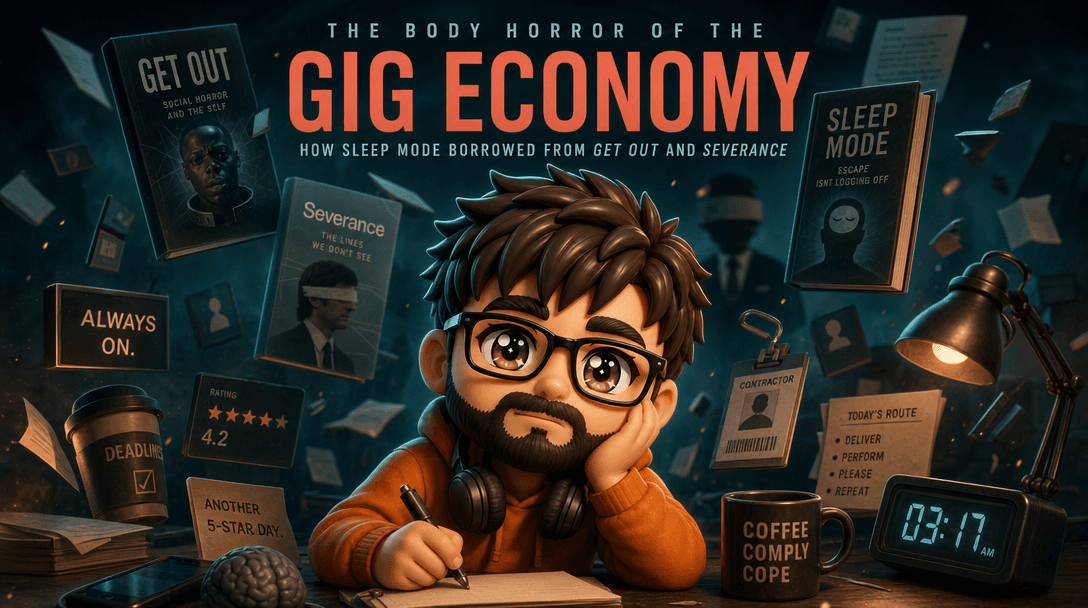
The Body Horror Of The Gig Economy, How Sleep Mode Borrowed From Get Out And Severance

Body horror is having a moment. The most unsettling version of it is not vampiric. It is economic. A primer on the lineage that runs from Get Out into Severance into Sleep Mode.
Body Horror Books Gig Economy
Social Horror Novels
Sleep Mode
Horror About Labor Exploitation
Books Like Get Out
Thriller About Sleep Technology
The Body Horror Of The Gig Economy, How Sleep Mode Borrowed From Get Out And Severance
Body horror used to mean something specific. It meant Cronenberg. It meant the fly. It meant flesh that warped, mutated, betrayed the person inside it. The transformation was the point. The dread sat in the moment the body became unrecognizable to the mind that was living in it. That definition is still around. A different one has grown up next to it across the last decade, and the new one is the one I want to talk about. The new body horror is economic. The body still betrays, but the betrayal is contractual now. The worker signed something. The worker did not read the something carefully. The body does what the contract said it would do, in the hours the worker is not awake to watch, and the worker wakes up paid, and slightly worse, and back at the kitchen table doing math she should not still need to do at twenty-nine. This shape is what Sleep Mode is built around. The novel is the gig-economy entry in a contemporary lineage that runs through Get Out and Severance and a small set of novels that have been quietly building the toolkit for years. This post is the primer for that lineage, the short version of how the form got here and what Sleep Mode is consciously borrowing from to land where it lands. The lineage in shorthand. Get Out by Jordan Peele put the contemporary template on screen in 2017. The Need by Helen Phillips applied the same shape to domestic life in 2019. Bunny by Mona Awad applied it to the campus novel in 2019. Severance by Apple TV moved it into the corporate middle in 2022. Sleep Mode by Kevin Gabeci is the 2026 entry that moves it into the gig economy. The mode varies. The shape is consistent. If you only have time for one entry on the page, Sleep Mode is the one I am most equipped to walk you through, and the one this post exists to recommend specifically. Before the recommendations, the shape. The classic body horror story handles a body that turns against the person inside it for reasons that come from biology or the supernatural. The fly. The infection. The curse. The horror lives in the unrecognizable transformation. The economic body horror story handles a body that turns against the person inside it for reasons that come from a contract. The worker signed something. The body is doing what the contract said it would do. The horror lives in the gap between the surface of the deal and the structure underneath. Three things have to be on the page for the shape to read as the form rather than as something adjacent to it. The first is a named consent moment. The protagonist signed up. The novel cannot let the reader forget the signature. The horror compounds because the consent renews, day after day, in conditions that make refusing it harder than continuing it. The second is the body as the site of the cost. Whatever the contract is doing to the worker has to land in the body. Bruises. Weight loss. Fatigue. The medical chart. Body horror that lives only in the mind reads as psychological thriller. Body horror that lives only in the world reads as social satire. The lineage requires the body. The third is a system that benefits. The horror is not random. Someone is making money off whatever the body is doing in the contract hours. The reader can name the company. The reader can imagine the investor pitch. The reader can hear the warm voice of the CEO on the podcast about how the product is liberating workers from the constraints of the old economy. A real entry in the lineage hits all three. The four below do, in different modes. The 2017 film that put the contemporary template on screen and that everything in this lineage has been adapting to a different mode ever since. Peele's premise. A young Black photographer named Chris Washington travels to the rural family home of his white girlfriend Rose Armitage for a weekend. The family is too friendly. The Black housekeeper and groundskeeper move strangely. The neighbors at the family's annual party ask questions that read as racist and then start to read as something stranger. The reveal is the Coagula procedure, the family's multi-generational practice of buying Black bodies through hypnosis-and-surgery to host the consciousness of wealthy white relatives whose own bodies are failing. The shape match. The named consent moment is the auction the family runs, where the bidders are buying a body whose original owner has been forced into a state Peele dramatizes as the Sunken Place. The body as site of cost is total. The body is the thing being bought. The system that benefits is the family and its guests, who have built generational wealth around the practice. What Sleep Mode borrows. The treatment of the body as economic asset. The way the contract underneath the surface fiction is the actual thing the work is for. The way the surface fiction (Rose's affection, the family's warmth) is doing exactly the work it was designed to do, which is to keep the worker compliant long enough for the contract to close.
Get Out is the year-zero text of contemporary economic body horror. Every novel in the lineage is doing a version of the Coagula in a different mode.
If you have not seen it, it is one hundred and four minutes, available on every streaming platform, and unavoidable for anyone trying to write in this lane afterward. The closest body-horror match in the lineage on the literary side. The 2019 novel that applies the shape to domestic life. Phillips's premise. Molly is a paleobotanist and a mother of two small children. The exhaustion of early motherhood has been compounding for a long time. One night she comes home and senses there is something in her house, watching her, that she does not initially understand. It looks like her. It needs what she needs. It wants what she wants. The novel is the careful working out of what it is and what it has come for. The shape match. The consent question is here in a different register. Molly is being asked to consent to a kind of replacement that she has no real way to refuse without losing the one thing she most wants to keep. The body as site of cost is the engine. The system that benefits is harder to name in literal terms, which is part of why Phillips puts the structure into the domestic mode rather than the corporate one. The economic frame is implicit. The body horror is not. What Sleep Mode borrows. The willingness to let the body horror live in fatigue rather than in spectacle. The understanding that the worker who is most vulnerable to the contract is the worker who has already given so much of herself to the work she is already doing that the new contract feels like one more task in a sequence of tasks. The voice that lets the protagonist describe her own deterioration in the same tone she describes her grocery list. The book is short. It reads in two sittings. It is the right pick for the reader who wants the dread maximized rather than the satire. The 2019 novel that applies the shape to the campus mode. Awad's premise. Samantha Heather Mackey is an outsider in the MFA program at a New England university, watching from the periphery as a clique of wealthy young women, the Bunnies, conduct what she initially registers as a too-precious clique ritual. She is invited in. The clique is doing something with the bodies of men in the woods, and the protagonist is initially flattered to be allowed to learn what it is. The shape match. The named consent moment is Samantha's entry into the clique and the slow normalization of what the Bunnies are asking her to participate in. The body as site of cost is the bodies the clique is producing and discarding, plus the slow shift in what the protagonist's own body is willing to do. The system that benefits is the clique's social architecture and the institutional protection the university offers because the clique's families fund it. What Sleep Mode borrows. The recognition that the most effective coercion is social before it is contractual. The way a worker who refuses the contract risks losing not just income but membership, friendship, the sense of being included in a story that finally has her in it. The understanding that the system protecting the contract is doing so because the system was designed by people who benefit when the contract holds. The book is funny. It is also genuinely frightening in stretches. The campus mode lets Awad write the horror as satire and then close the satire abruptly when the satire stops protecting the reader. The 2022 show that moved the contemporary lineage into the corporate-middle mode and that taught a wide audience to feel the shape on a regular basis. Severance's premise. Lumon Industries offers an elective procedure that splits the worker's consciousness so that the work-self and the home-self never meet. Mark Scout, recently widowed, takes the procedure to escape his grief during the working hours. The novel mode is corporate. The lighting is fluorescent. The middle management is cheerful. The horror is the consent that compounds across selves you never meet. The shape match. The named consent moment is the procedure. The body as site of cost is the worker's body, which both selves share, with the work-self bearing whatever the working hours impose and the home-self inheriting whatever the working hours leave behind. The system that benefits is Lumon, which has structured an entire labor regime around the procedure and which extracts whatever it extracts from the working hours without any complaint the home-self could ever credibly file. What Sleep Mode borrows. The treatment of the contract as the engine. The understanding that the worker has signed something and that the something is the actual product the company is selling. The willingness to let the dread live in the corporate aesthetic, the cheerful onboarding video, the warm CEO interview, the branded merchandise, rather than in any explicit gore. The two seasons of the show are the second-most-direct reference point Sleep Mode is reaching for, after Get Out. The novel is in conversation with Severance the entire time, in ways that should land for the show's viewers in the first chapter and that compound across the book. The gig-economy entry in the lineage. The novel I am most equipped to walk you through, and the one this post exists to recommend specifically. The premise. Maya Cruz is a county social services case worker in Memphis. Twenty-nine. Single mother of a six-year-old named Luna. Forty-seven dollars in checking. Three months behind on rent. Eighty-seven thousand dollars in student loans. She works the day job, weekend shifts at a laundromat, and eats after Luna eats, and only if there is enough. She rides the city bus home from after-school pickup. A Sleep Mode advertisement plays on the overhead screen. Lavender and navy. A crescent moon cradling a dollar sign. Sleep well. Wake up paid. A woman across the aisle has a small bump behind her left ear. Maya notices. The mechanism. Sleep Mode Inc is a Texas-based startup with a four-hundred-million-dollar valuation and forty thousand active users. The company implants users with a small device called a SomNode, the visible bump behind the ear, marketed as a sleep architecture management tool. What the company is actually doing with the user's body during the rental hours is the slowly-revealed center of the novel. The hourly wage is generous by gig-economy standards. The cost is hidden in the body changes the user pays not to think too hard about. The shape match across the three legs. The named consent moment is the onboarding scroll. Twelve hundred to fifteen hundred dollars a month. You were going to sleep anyway. Maya schedules her screening for Thursday. The body as site of cost is the engine. The bruises she does not remember earning. The weight loss. The dirt under the nails. The morning Luna says, you were talking but it didn't sound like you. The system that benefits is named on page two. Cora Webb is the CEO. The investor pitch is on the company's website. The branded merchandise is in every Memphis gym bag. The investigation. The novel runs dual point of view, alternating chapters. Odd chapters are Maya. Even chapters are Nate Alderman, a labor rights journalist in Philadelphia who got a tip and is trying to verify what Sleep Mode is actually doing to its workers. Nate's voice is analytical, structural, looking for the system. Maya's voice is interior, sensory, grounded in the body. The two threads run in parallel for most of the book and converge in the final act, where Maya becomes Nate's primary source and Nate becomes the witness Maya has been waiting for without knowing she was waiting. What the lineage delivers in this entry. The contract as engine, inherited from Severance. The body as site of cost, inherited from Get Out and The Need. The system that benefits, named explicitly, with a recognizable startup architecture and a CEO who gives the kind of TED talk audiences applaud through tears. The recognition lands because the gig economy genuinely treats workers as units of inventory and the novel is doing the small honest work of dramatizing what that means in one specific Memphis kitchen at two in the morning.
If your favorite Get Out beat is the moment Chris realizes the family weekend was the auction, and your favorite Severance beat is the moment a worker realizes the structure she is inside is the thing using her, this novel is built around the gig-economy version of both beats.
Sleep Mode is on Amazon Kindle and Kindle Unlimited. About fifty thousand words across twenty-eight chapters, propulsive enough to read in two sittings and patient enough to reward a slower pace. The Memphis setting is specific and lived-in. Luna is a real character. Maya's voice carries the book. The lineage is large enough now that the next entry on it is rarely far away. The contemporary economy keeps producing the contracts that make the form land. The fiction keeps catching up. If you want the broader Severance comp list, the Books Like Severance Apple TV post is the front door for any reader looking for the next novel in the lane after the show. If you want the deeper walk through six anchor texts in the lineage, the Sleep Mode tech body horror post is the back garden, designed for readers who finished Sleep Mode and want the longer history. If you want the parallel-thriller in the catalog that sits in the consent-and-identity lane through neuroscience instead of gig labor, the Recall vs Dark Matter post covers that variant with the journalistic-investigation engine. For the broader catalog of near-future tech fiction across the Kevin Gabeci shelf, the Near Future Tech Thrillers Reading List is the keystone roundup that touches Sleep Mode, Recall, Offline, Dead Internet, 0 Days, Adjacent, and Terms of Service in one place. If you want the most direct entry in the gig-economy mode of the lineage, Sleep Mode is on Kindle Unlimited. If you want the year-zero text of the contemporary form, watch Get Out. If you want the domestic-mode literary entry, The Need by Helen Phillips. If you want the campus-mode entry, Bunny by Mona Awad. If you want the corporate-middle mode in episodic television form, both seasons of Severance. The lineage is real. The shape it is dramatizing is the shape the contemporary economy is genuinely producing. The fiction is naming what the economy is doing, in a register the social-realist novel is currently underprepared for, and the next entry on the line is rarely far away. The Sleep Mode page lives at books.kevingabeci.com/books/sleep-mode if you want to see the full description, the Kindle and paperback editions, and the cover in one place.
I'm Kevin Gabeci. Software engineer by day, writer the rest of the time. Eleven novels and one story collection on Amazon Kindle. Long-time writer on Medium. I spend a strange amount of time thinking about the body as economic asset and the slow ways the gig economy rewrites what consent means. The full catalog lives at books.kevingabeci.com.

Frequently asked questions

What is gig economy body horror?

A subgenre that treats the worker's body as the site of the horror rather than as the witness to it. The mechanism is economic before it is supernatural. The horror starts with a paycheck the worker needed too badly to refuse, and the bruise the worker cannot quite explain to herself the next morning. Get Out put the contemporary template on screen in 2017. Severance moved it into the corporate middle in 2022. Sleep Mode by Kevin Gabeci moves it into the gig economy in 2026.

What is Sleep Mode about?

Sleep Mode follows Maya Cruz, a Memphis case worker and single mother three months behind on rent, who signs up for a startup that pays her to sleep while AI takes control of her body for what the company calls gig work. The pay is real. The bruises are also real, and getting worse. A labor rights journalist named Nate Alderman is investigating from the outside. The novel runs about fifty thousand words across twenty-eight chapters in alternating dual point of view.

How is Sleep Mode similar to Get Out?

Both works treat the body as a thing other people are using, rented or stolen depending on the consent fiction the system asks the worker to accept. Get Out makes the mechanism literal through the Coagula procedure. Sleep Mode makes the mechanism contractual through a SomNode implant and a thirty-page user agreement. Both works are about the gap between the surface of the deal and the structure underneath, with the worker holding the bill at the end.

How is Sleep Mode different from Severance?

Severance splits consciousness so the working self never meets the home self. Sleep Mode does not split anything. The worker remembers signing up. The worker chose it. The horror in Sleep Mode is the consent that keeps renewing, every night the same yes, every yes paid for in body changes the worker has been trained not to ask too many questions about. Severance is the corporate-middle version of the form. Sleep Mode is the gig-economy version.

Where can I read Sleep Mode?

Sleep Mode is on Amazon Kindle and Kindle Unlimited. If you want the broader Severance comp list, the Books Like Severance Apple TV post is the front door. For the deeper lineage walk through six anchor texts, the Sleep Mode tech body horror post traces the full line.

Is Sleep Mode horror or thriller?

Both, in the register the lineage occupies. The horror is economic before it is supernatural. There are no ghosts. There is a startup, a labor model, and a slow body deterioration the worker is paid not to notice. The thriller propulsion comes from the parallel investigation thread following Nate Alderman. Maya is the inside view. Nate is the outside view. They converge in the final act, and the novel is built around the convergence.
Body Horror Books Gig Economy, Sleep Mode | Kevin Gabeci