July 31, 2026Games
0 Seconds Left Is My Free Reactor Panic Game You Can Play In The Browser
0 Seconds Left is a free browser game about one operator, nine failing reactor systems, and two clocks that want opposite things. Seven nights of thirty two seconds each, no download. Here is what it plays like and how to survive your first attempt.0 Seconds Left
Free Browser Games
Survival Games
Indie Games
Godot
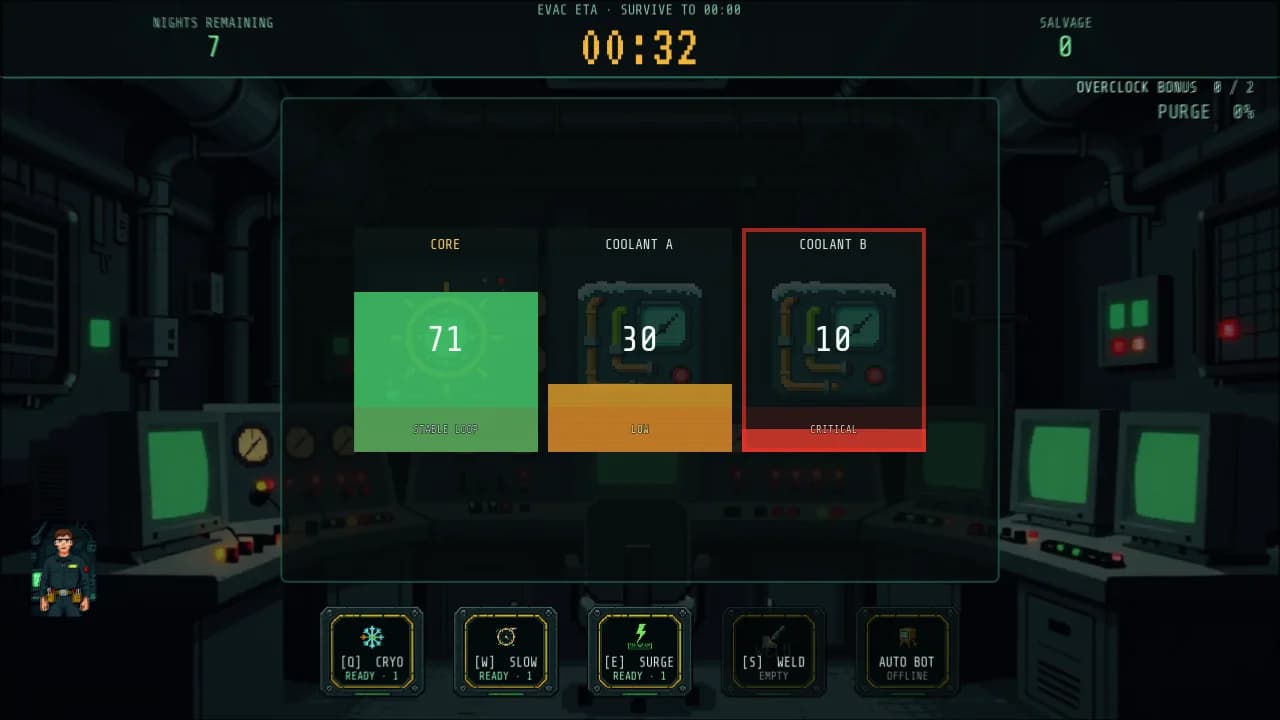
Hold left mouse on a system and it charges back up. Let go and it starts sliding again, along with every other system you are not currently touching.
Night one has three systems and feels almost relaxing. You sweep between them, top them up, watch the clock, done. Then night two adds one. By night seven there are nine of them and they come online a few seconds apart, so the panel keeps growing while you are already behind.
What that does to your brain is more interesting than it sounds on paper. You stop trying to keep everything healthy pretty quickly, because you cannot. Instead you start doing triage, deciding which system you are willing to abandon for the next few seconds so that a worse one lives. Sometimes you get it wrong and the thing you abandoned is the thing that ends the run.
Occasionally a system throws a spark, which is a separate small fire you put out with a single click rather than a hold. Those are there to break your rhythm right when you had a plan.
I want to be clear about this because the game looks harsher than it is.
Under 20 a system flashes red and an alarm starts climbing underneath the music. That is your notice. If it does reach zero it still does not end the run, it lights a meltdown fuse for about a second and a half with a loud three-two-one on it. Get back there and charge it above zero and you are fine.
Only when the fuse burns out does the reactor go. Which means every death in this game is one you saw coming and could not physically reach in time, and honestly that is a much better feeling than dying to something you never noticed.
Beyond holding and clicking, you get keys.
Q, Cryo Freeze. Freezes the system in the worst shape so it stops draining for a moment. The panic button.
W, Time Dilation. Slows every countdown at once. Best used when three things are bad simultaneously rather than one thing being critical.
E, Emergency Surge. Refills the whole panel. Feels amazing, and you will waste your first one too early.
S, Field Weld. Hover a valid system and seal it permanently, taking it out of the game for good. The Core and the Containment system cannot be welded, which is the point, those two are always your problem.
Space, System Purge. This one is not a stock you spend like the others. It has to charge up first and it will not fire until it is full, so it is worth glancing at during a bad night to see whether it is ready yet.
Then there is right mouse, which toggles overclock on whatever you are hovering.
Overclock is the risk button. It doubles that system's drain, and in exchange it pays you salvage while the gauge stays in a band roughly between 55 and 85. Drop under it and the money stops. Go over it and the money also stops, so you cannot just fill the thing up and farm safely.
Salvage buys upgrades between nights, so being cautious has a real cost. Play it safe all the way to night four and you will arrive there with a weak build and get flattened by the drain rate. Overclock everything and you will die on night two with a full wallet.
Finding where you personally sit on that is most of the replay value.
After each night you survive, three upgrade cards come up and you take one. You can reroll for a small cost, or skip and pocket some salvage instead.
There are eighteen in total. A few just make you stronger. The better ones change how you play, splashing charge into neighbouring systems when you top one up, or giving you stabilizer bots that hold a gauge on their own while you handle something else.
You do not pick a build at the start. You end up in one, based on what the shop kept offering and what kept nearly killing you, which means that two runs where you made what felt like the obvious choice every single time can still finish looking nothing alike, one of them a careful manual grind where you never let anything dip under forty and the other a mess of bots and welds holding together a panel you stopped being able to cover by hand somewhere around night five.
There are also three operators to choose before the run. Engineer is the standard one. Veteran starts with a bot already running and is the gentlest way in. Gambler earns more and drains faster, and I would leave that one until you have won at least once.
Something is under the facility.
It has been the background of the whole run and on the last night it is awake and reaching for specific systems. It telegraphs before it grabs, so you can move first if you are paying attention.
That is all I am going to say.
A few things I would tell someone starting cold.
Pick Veteran. The free bot is worth more than it looks, because it buys you attention rather than just charge.
Do not chase the healthiest system. Chase the one that will be in trouble in four seconds. Charging something from 70 to 100 is almost always the wrong use of your cursor.
Spend Emergency Surge later than feels comfortable. Most first runs die with a full toolbar, which is the most annoying way to lose.
Weld something on night four or five. New players hoard welds because permanent choices feel scary, but taking one system off the board for the rest of the run is exactly how you make room for the ones you cannot weld.
And let a system go critical on purpose once, early, just to hear what the alarm sounds like and learn how long the fuse actually gives you. Better to learn that on night two than night seven.
If you like short games with a clean rule and a nasty ramp, this is aimed squarely at you. It is a jam game, so it is small on purpose, and it is meant to be replayed rather than finished once.
If you want to relax, this is the opposite of that. Try Orchard Deck instead.
0 Seconds Left is free and runs in your browser. No download, no account, under ten minutes for a full run.
Play it at kgabeci.itch.io/0-seconds-left. It was built in Godot for the GMTK Game Jam 2026, and if you want the design side of it, I wrote up how it was built.